
Davos Tech Summit 2027: Physical AI’s Reality Check
The Davos Tech Summit is a major international event that serves as a living laboratory for the future of physical AI and applied robotics.
By Rahul Karunakar, Editor-in-Chief
· 8 min read
The yearly meeting of the World Economic Forum has long been the place where big digital future predictions are made.
However, a different kind of peak is quietly leaving a more lasting mark on the Swiss Alps.
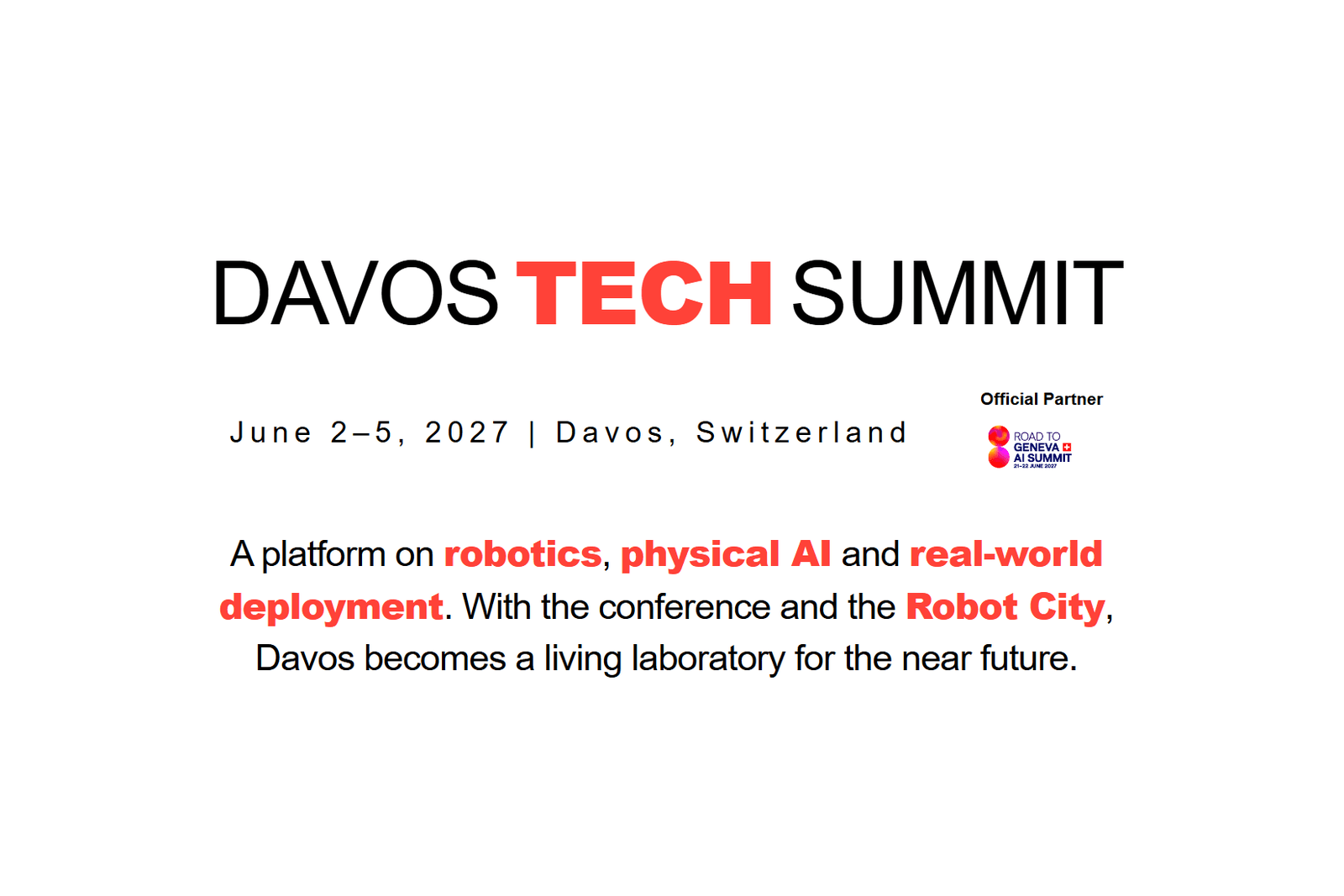
The Davos Tech Summit will be back from June 2–5, 2027. Its main idea is very different from the normal panel discussions and policy papers that define Davos.
The focus is on physical AI, which means smart machines that can move, change, and work in the real world. And the format is meant to be annoying: "Robot City" will once again spread out across town, bringing robots, quadcopters, and drones into shops, hotels, construction sites, and care homes.
It's not a trade show. It's a test of stress. And the timing is very important.
The robotics and physical AI industries around the world have a lot of money but not much proof.
There will be a lot of money for the Davos experiment in 2027, with strong Chinese state-backed manufacturing, strict European rules that need to be followed, and a growing gap between what robots can do in the lab and what they can do on the street.
The Capital Flood and the Deployment Deficit
This is not about the money.
Robotics and physical AI startups raised a record $18.6 billion in 450 deals in the second quarter of 2026. This was a 25.3% increase in deal value from the previous quarter, even though the number of deals decreased.
The growth isn't just big deals like Anduril's $5 billion round. AI platforms, actuators, motion systems, and end effectors are some of the software and parts that make autonomy possible. Investors are putting a lot of money into these areas.
The rate of spending has been even faster in China. The amount of money spent on embedded intelligence in the first five months of 2026 was 48.9 billion yuan, which was more than the whole of 2025.
But money isn't the same thing as skill.
The data point that makes people uncomfortable is China's humanoid robot industry. About 95% of the world's humanoids are made in this country, which sent out about 20,000 units last year.
China wants to build more than 100,000 by 2026. Unitree's Shanghai IPO put the company's value at about $50 billion for a short time.
But output in the real world is still very low. Robots are only about 20% as productive as humans, and in places like Liuzhou, it can take up to 300 tries for a new operator to get a robot to move in a useful way.
The difference between value and usefulness is not a side note. It's the most important risk in the sector.
The Robot City format of the Davos Tech Summit directly addresses this. There needs to be something that people can see, hear, and interact with during deployments.
It's important that the machine works. It doesn't have to be fully business-like yet.
That difference is important.
Those in charge of the event are admitting that the sector is still in the validation phase and not the rollout phase.
In 2027, it won't matter if robots can walk or not. It's whether they can do the job that makes the money worth it.
China’s Manufacturing Grip and the European Retreat
There are already clear political fault lines in physical AI.
China is almost completely in charge of making humanoid robots, and its base of industrial robot installations is growing faster than anywhere else in the world.
The International Federation of Robotics says that in 2025, 354,000 industrial robots were installed in Chinese factories, which is 59% of the total number of robots used around the world. 55% of their own market was supplied by Chinese manufacturers.
Europe, on the other hand, is going the other way. It dropped by 8% in Germany, 11% in Italy, 8% in France, and 15% in Spain. It was down 11% year-over-year in the EU-27, which put it at 60,500 units in 2025. At the same time, the world's operational stock passed five million units.
There are effects on the European host of the Davos meeting from this disagreement.
The continent is falling behind in putting automation to use, even though it is building the rules that will govern it. The EU AI Act's high-risk classification rules for embodied systems will go into effect in December 2027.
However, safety components that need to be evaluated by a third party will have extra time until August 2028. That means that when robots walk through Davos in June 2027, they will be following rules whose strictest requirements won't go into effect for months.
In a way, the summit is a sneak peek at the compliance burden that's to come.
The Data Moat and the Software Shift
The most important change in the structure of physical AI is not in the hardware. It's in the records.
According to PitchBook's study of Q2 2026, the most significant growth is occurring in the software and parts that support autonomous systems.
In fact, AI and autonomy platforms have received $7.7 billion in funding over the last twelve months. The economic reasoning is simple: whoever has the operational data gains the ability.
A fleet that is already in use creates the edge cases that make the model better, giving the company an advantage that a later entrant can't just buy.
This is where the style of Davos becomes interesting from a strategic point of view.
Robot City is not a museum that stays put. It's like a living lab. Every deployment in a hotel, on a construction site, or in a care home creates operational telemetry, failure modes, and interaction data.
The summit gives companies that are chosen to deploy something that capital can't easily provide: a controlled, real-world setting where a jury, the tech community, and the public are all watching.
The categories for the Robot City Award—most impactful real-world deployment, robot for society, and people's robot—show what the organisers care about. Not new technology. Used in a useful way.
The difference with the market as a whole is instructive.
Funding for humanoid robots is very focused. Humanoid robotics got $4.39 billion in the first half of 2026, but 78% of that money went to just six companies. China, the US, and Germany gave 97% of the world's funding.
On the other hand, the Davos summit makes it clear that applications that are not yet commercial are welcome. For some use cases, there are free deployment slots available.
This openness is meant to counteract the way the venture capital markets are getting smaller.
The Regulatory Clock and the Liability Question
The rules that govern the physical AI sector were not made with machines that move in mind. The high-risk parts of the EU AI Act will cover a lot of embodied systems, not because they are robots but because they work in situations where failure could be dangerous.
Ex ante conformity assessments, transparency standards, and human oversight are all needed for compliance. There are long lead times for conformity evaluation, and the standards and common specifications that will make the Act's application clear are still being developed.
The picture is patchy in the United States.
There is no complete AI law at the federal level. A growing number of state laws are being added by sector-specific regulators like the NHTSA and FDA. The current administration has taken a "de-regulatory" stance and made it clear that they want to override state AI rules, but this has not yet been done.
The European regulatory clock is the hard and fast rule for robotics companies that want to set up shop in Davos in June 2027.
The summit is being held six months before the deadline for high-risk systems to comply in December 2027. This makes it an unintentional compliance practice.
The question of liability is also unclear.
Layered ecosystems are needed for embedded AI systems. These ecosystems include AI developers, robotics makers, semiconductor suppliers, infrastructure operators, and platform companies.
Operational responsibility is spread out among many people, making it harder to tell the difference between product liability, software liability, and infrastructure accountability.
Who is to blame when a four-legged robot working in a Davos hotel corridor breaks down?
The real-world deployments at the summit won't answer that legal question, but they will make it real.
What to Watch in Davos
There will be three signs that matter in June 2027. First, the ratio of deployment to demo.
How many of the robots in Robot City are actually cleaning, delivering, checking, or helping people, and how many are just standing on plinths for pictures? The organisers have made their requirements clear: the machine has to work.
If you want to know where the area really stands, look at the difference between those two groups.
Second, the fact that Chinese and American platform players are present. Based on the funding concentration data, it looks like the race to make humanoid robots is already down to a few companies that have the money and data to go big.
It's possible for Davos 2027 to become a regional showpiece instead of a global standard if European integrators and academic consortiums run the show while Chinese and American leaders stay at home.
Third, the response from the public. 450 people came to Family Day in 2026. The last day of the meeting is open to everyone and doesn't require registration.
Anyone can walk into this town and see robots at work and the people who make them. The most radical thing about the summit is that it is open to everyone.
Investors believe in physical AI, but it won't be used.
People will agree with it, so it will be used. Trust isn't built in meeting rooms; it's built in streets, shops, and care homes.
The 2027 Davos Tech Summit is not a celebration of real AI. There is a test for it.
There is more money than ever in the sector, China has manufacturing capacity that has never been seen before, and Europe is about to set the standard for regulation around the world.
What it doesn't have is proof that the machines can make a lot of money.
Robot City won't be able to fix that in four days. But the difference between the hype and the real world will be clear in public, on the street, where it matters.
For years, this business has been talking about the future. Now, in June 2027, it's time to show the present.
SKAAH Media will be tracking the developments throughout the event.
Rahul Karunakar
Editor-in-Chief
Rahul Karunakar is Editor-in-Chief of SKAAH Media, with 25+ years of experience in business journalism across Reuters, NDTV, and WION. An expert in macroeconomics, financial markets, and monetary policy, he leads editorial teams delivering trusted news across TV, web, and social platforms to mass audiences and institutional clients alike.
Comments
Comments are not open on this story. Join the conversation by sharing it, or write to our editors.